
SEO still matters in AI search. A practical approach starts with crawlable pages, useful original content, accurate structured data and careful measurement—not speculative tricks or promises of AI citations.
Search is changing, but the fundamentals still matter
Search is no longer limited to a list of blue links. People can now explore AI-generated summaries and conversational experiences that combine information from different sources.
For website owners, that creates a practical question: How can content remain discoverable, understandable and trustworthy across traditional and AI-powered search?
The answer is not simply to add more keywords, publish hundreds of generic articles or create special files for AI crawlers. It starts with accessible pages, useful content and reliable ways to measure outcomes.
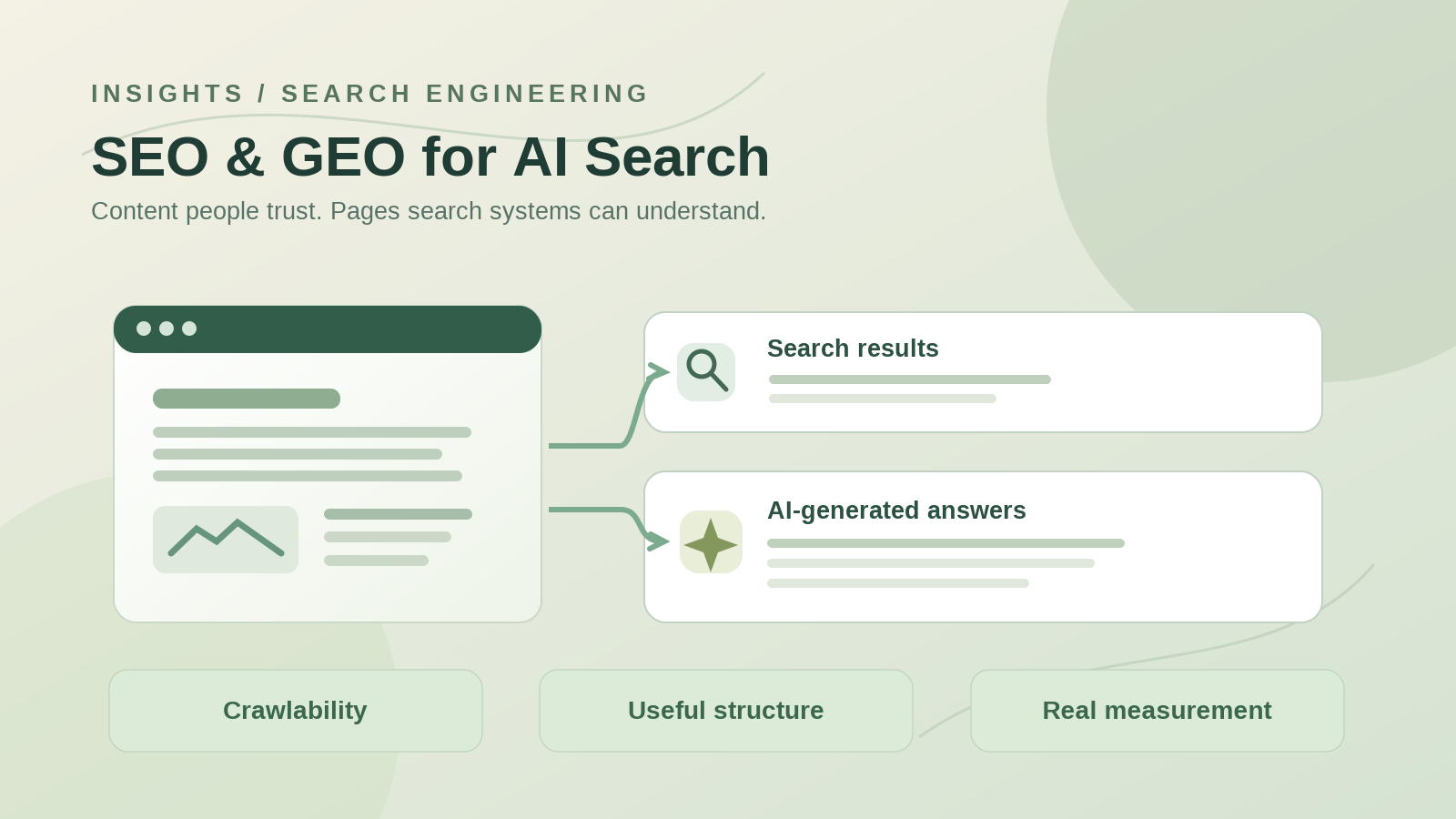
SEO and GEO: What is the difference?
Search Engine Optimization (SEO) helps make web pages accessible, understandable and useful for search engines and visitors.
Generative Engine Optimization (GEO) is a broad industry term for efforts to help information be discovered and referenced in AI-generated search experiences. Its definition and measurement practices are still evolving.
The two concepts overlap substantially. Both benefit from original, accurate material, clear page structure, discoverable links and evidence readers can inspect.
Google explicitly says its existing SEO best practices remain relevant to AI Overviews and AI Mode. Google does not require special AI-specific optimizations or structured data to be included in those experiences.
What changes is partly what we observe: an organic click, a search impression and an AI citation are different events, and none alone proves meaningful business value.
1. Establish the technical foundation
Before discussing AI visibility, make sure the page can be accessed and understood.
A useful technical audit asks whether:
- The correct page returns a successful HTTP response and is not unintentionally marked
noindex. - Canonical URLs and redirects consistently identify the preferred page.
- Important articles are linked from navigable pages and included in a maintained XML sitemap.
- The main information is available as readable HTML, with descriptive titles and headings.
- The experience works on mobile and important images have useful alternative text.
These are foundational SEO checks, not guaranteed triggers for AI recommendations.
2. Write for real questions, not keyword variations
A good article lets the reader understand what problem it addresses, what evidence supports the answer and where uncertainties remain.
Instead of repeating a phrase across many headings, aim for:
- A clear explanation near the beginning.
- Descriptive sections that answer genuinely different questions.
- Original examples, implementation notes or firsthand observations when available.
- Links to primary sources for claims readers may want to verify.
- Honest limitations rather than unsupported certainty.
This also makes the material easier to interpret when a retrieval system examines a relevant passage. It does not guarantee that an AI product will cite the page.
3. Use structured data accurately
Structured data can describe a page’s type and attributes in a machine-readable form.
For example, appropriate Article or BlogPosting metadata may identify the headline, author, publication date and representative image, provided it matches the visible page.
That information can improve understanding and eligibility for certain search features. But Schema markup is not an AI-citation switch, and there is no special Google requirement to add AI-specific Schema for AI Overviews or AI Mode.
Validate markup and keep it aligned with what visitors can actually see.
4. Make expertise verifiable
For a technical portfolio or engineering blog, a useful case study is more credible when it explains what was built, what was tested and what is still a prototype.
Examples of verifiable evidence include an accessible public repository, an architectural decision, a reproducible test, a documented methodology or an accurately attributed primary source.
Not every project can share its source code. When confidentiality applies, use synthetic examples and clearly label any mock diagrams. Avoid treating a marketing description as implementation evidence.
5. Measure different outcomes separately
A practical measurement framework distinguishes the kinds of evidence rather than compressing everything into a single unexplained “GEO score”.
| Area | What to examine | What it does not prove |
|---|---|---|
| Crawl and indexing | Indexed pages, crawl problems, canonical consistency | Whether someone found the content useful |
| Traditional search | Queries, impressions, organic clicks | That a specific content edit caused growth |
| AI citations | Supported AI-search citation reporting and cited pages | Clicks, rankings or commercial impact |
| Engagement | Useful interactions and engaged sessions | That every visitor arrived through AI |
| Business impact | Qualified inquiries or another defined conversion | That SEO alone caused the outcome |
Google Search Console offers reporting for search visibility and generative AI features where available. Bing Webmaster Tools’ AI Performance report provides aggregate citation activity from supported Microsoft AI experiences.
Bing notes that its citation counts are not rankings, clicks or a complete log of every AI answer. Treat metrics from different providers as distinct signals with different coverage.
6. Test improvements, then interpret carefully
A measured approach is more credible than a promise of rankings:
- Select a relevant, bounded group of pages and record a baseline.
- Check technical discoverability and indexing.
- Improve clarity, factual support and genuinely useful details.
- Review structured data for accuracy against visible content.
- Record what changed and when.
- Monitor organic search and any available AI citation data over time.
If performance improves, that is useful information—but not automatic proof of causation. Search demand, competition, crawling, indexing and AI system behavior can all change during the same period.
What I take from this
SEO and GEO should not become a competition between established web fundamentals and new optimization tricks.
A better question is: Are we building pages that can be found, understood, checked and genuinely used?
Technical SEO makes information accessible. Good editorial work makes it worth discovering. Careful measurement helps distinguish visibility from useful outcomes.
That is a more sustainable approach to AI search than promising citations or rankings that no website owner can guarantee.