
A natural-language command becomes useful only when the surrounding system can explain its source, validate permissions and stop unsafe actions. This in-development case study separates working read-only previews from the stronger controls still required for authorized production writes.
An AI command is not the same as an authorized business action
“Approve this completed task” sounds like a simple request. A conversational model can parse the words and identify the intended action. But in a real organization, approval has consequences: the request needs a verified identity, the correct task, the right permissions, a fresh status check, and a durable record of what happened.
That gap between understanding an instruction and safely executing it is what I have been exploring while developing an AI-assisted management portal.
This article describes a work in progress, not a production launch. To avoid exposing proprietary company information, its diagrams, example task names, identifiers and workflow scenarios are synthetic. The implementation statuses below are based on a dated technical checkpoint, not a claim that the entire system works end to end.
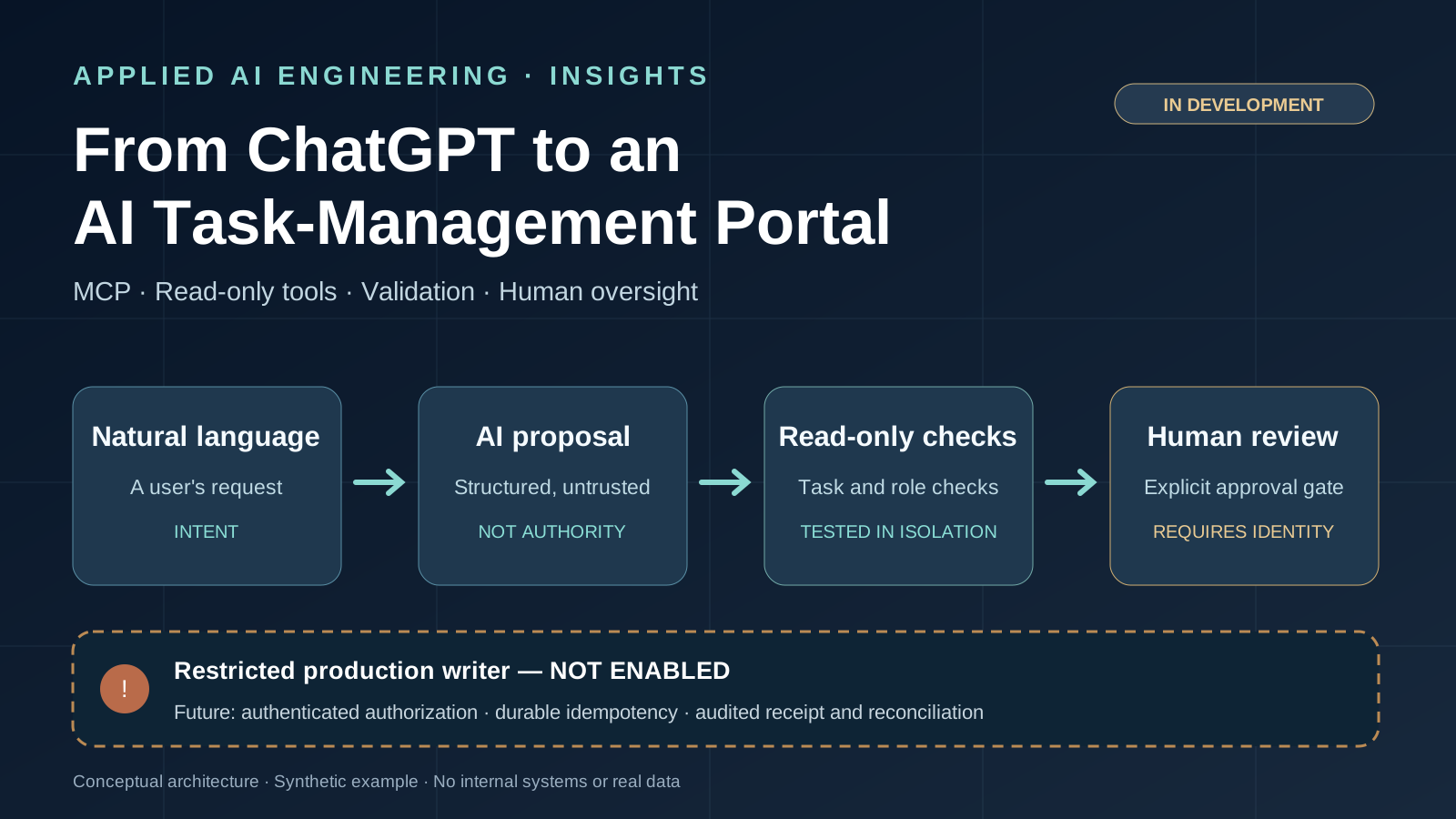
Start with the workflow, not the model
The proposed experience is straightforward: a manager states an intention in natural language, and an assistant helps find the relevant task or prepare a structured proposal. The risky part comes later, when the application must determine whether an action can actually be executed.
I divide that journey into four separate concerns:
- Interpretation: understand what the person is asking and ask for missing fields instead of inventing them.
- Retrieval: collect relevant task state through tightly scoped, read-only tools.
- Decision preparation: validate the intended change, its target, permissions and business rules; show a human-readable preview.
- Execution and reconciliation: only after authenticated human approval and further policy checks, submit an allowed change through a restricted writer and record a verifiable receipt.
These stages have different levels of trust. A model’s suggestion is not proof that a person is authorized to act, and an attractive button is not a security boundary.
What MCP contributes—and what it doesn’t
Model Context Protocol (MCP) can standardize how an assistant discovers or invokes tools exposed by a connected service. This makes it useful for a system that needs controlled access to task data.
However, MCP is an interface protocol, not an automatic authorization system. An MCP tool can be read-only, or it can expose a privileged operation; the surrounding architecture must decide which is appropriate. Authentication, task-level authorization, input validation and auditing still belong in the trusted application and integration layers.
In my current experimental workflow, the relevant progress has been on the read-only side: retrieving a task, comparing it with its expected project and board, and preparing a decision preview. That is valuable engineering progress, but it does not establish permission to approve or reject real tasks automatically.
A developing portal: verified versus proposed
The latest dated technical checkpoint I used for this article records an isolated preview environment, role-oriented UI tests, and an operational command-line read-only preflight. That checkpoint is a record of previous VM observations—not a live production audit.
| Capability | Evidence-aware status |
|---|---|
| Isolated management preview and role-specific decision-preview buttons | Demonstrated in a test environment |
| Read-only task and board retrieval | Checked in a dated read-only sweep |
| Command-line preflight for task identity and expected state, with a local audit record | Demonstrated in testing |
| Wiring that preflight into the portal’s decision endpoint | Not yet established in the checkpoint |
| Independent CEO identity, production-grade authorization and stronger session controls | Still required |
| Durable task-global idempotency, restricted write service and post-write reconciliation | Not established |
| General production approval/rejection by conversational command | Not enabled or claimed |
The distinction matters. A successful read or preview means the system can prepare a decision. It does not mean a chatbot is already allowed to make decisions in the company’s system of record.
Three engineering lessons from the process
1. Read-only access is a meaningful first milestone
It’s tempting to demo the most impressive action first. I prefer starting with questions the system can answer safely: Does this task exist? Is it in the expected board? Is it actually marked complete? Does the retrieved state match what the reviewer expects?
This is also where data provenance becomes important. A summary based on an old snapshot should not look identical to a freshly checked task state. The application needs to expose where the information came from and when it was checked.
Read-only access is not risk-free—it still needs authentication, data scoping and privacy controls—but it limits the impact of mistakes while the system is being developed.
2. Validation must be outside the language model
The assistant can help fill a structured proposal, but deterministic checks should decide whether it is admissible. Examples include verifying task identifiers, roles, expected workflow status, request shape and approval scope.
For a write-capable system, a safe proposal might contain a task reference, requested decision, reason if required and an expected version. The server—not the model—must check those fields against trusted current data.
A preview or a conversational “yes” is not enough unless it is bound to an authenticated decision maker, an exact operation and a fresh state.
3. “Try again” is not a reliable transaction strategy
Network timeouts introduce a subtle problem: after a request fails to return, did the underlying task change happen or not?
A future write gateway needs a durable idempotency policy tied to the actual task and decision, explicit handling for unknown outcomes, and independent reconciliation against the system of record. Otherwise a model or UI retry could submit an unintended duplicate operation.
The current checkpoint demonstrates some request-ID repeat protection in an isolated preflight, but it does not demonstrate robust task-global idempotency across different request IDs. That is an open requirement, not a solved feature.
A conceptual trust boundary
For a synthetic example, the intended architecture can be written as:
Person → Natural-language request
        ↓
Assistant → Structured proposal (untrusted)
        ↓
Authenticated API → Input + scope checks
        ↓
Read-only task retrieval → State verification
        ↓
Human-visible preview → Explicit human approval
        ↓
Future restricted writer → Receipt + reconciliation
The restricted writer at the end is deliberately a future component in this example. It should not be inferred from the existence of the upstream stages.
The approach also creates clearer test boundaries: malformed requests must fail; a reviewer must not see unauthorized tasks; stale decisions must not proceed; duplicate or unknown outcomes must be reconciled rather than assumed successful.
What comes next
The immediate engineering task is to connect the demonstrated read-only preflight to the isolated portal preview through a narrow, carefully reviewed gateway, without introducing general write authority. Beyond that are independent authentication, authorization and session safeguards, task-level idempotency, a narrowly scoped writer and reliable audit/reconciliation.
I consider the larger lesson more important than any individual library: a useful AI system is built as much from permission boundaries, evidence and failure handling as from natural-language capability.
Connecting a model to tools is a starting point. Building software people can trust to use those tools is the engineering challenge.